How Much Does a Virtual Receptionist Cost per Month? 2026 Comparison
Telofia team · · 9 min read
How much does a virtual receptionist cost per month? From around a hundred to a few thousand pounds, depending on the billing model (salary, per minute, per call or a plan with a minute allowance), your call minutes and extra fees. Per-minute and per-call bills grow with call volume; an AI plan only changes once you exceed its allowance.
Contents
- How much does a virtual receptionist cost per month?
- What are your options and how is each one billed?
- A worked example in pounds: what do 200 calls a month cost?
- How do you work out the monthly cost for your own business?
- Which hidden costs push up the bill?
- How much do you pay for an AI receptionist with Telofia?
- What should you check before signing a contract?
- How can you check the cost on your own calls?
- Frequently asked questions
How much does a virtual receptionist cost per month?
Three things set the monthly cost of a virtual receptionist. The first is the billing model: salary, per minute, per call or a plan with a minute allowance. The second is your number of call minutes, and the third is extra fees.
So the same service can cost a hundred pounds or a few thousand. It all depends on how often your customers call and how long they stay on the line.
A virtual receptionist is a service that answers your business calls remotely. The calls are handled either by a person from an external team or by an AI phone assistant.
If you'd first like to understand when AI makes sense at all, read Answering Service vs AI Receptionist: Which Is Better in 2026?.
What are your options and how is each one billed?
You can handle your business calls in four ways. Each one has a different payment model and different traps in the price list.
| Option | Billing model | Availability | Typical hidden costs |
|---|---|---|---|
| In-house receptionist | Fixed salary plus employer costs | Working hours, one call at a time | Holidays, sick leave, cover, a workstation |
| Call answering service | Plan with a minute allowance plus a per-minute rate | Usually weekdays, sometimes longer | Extra minutes, out-of-hours surcharge, setup |
| Virtual receptionist (remote human) | Plan with a call allowance plus a per-call fee | Agreed hours of cover | Fees for additional calls, script changes |
| AI receptionist | Fixed plan with a minute allowance | 24/7, from 1 to several calls at once depending on the plan | Extra minutes, SMS above the limit |
When people answer your calls, the bill grows with the number of calls. A salaried receptionist always costs the same, but is limited by one person's working hours. An AI plan usually only goes up once you exceed the minute allowance.
A worked example in pounds: what do 200 calls a month cost?
Example — assumptions: a service business, e.g. a plumber with two crews, takes 200 calls a month. The average call lasts 3 minutes, which gives 600 minutes. 60 of those 200 calls come in out of hours.
All rates below are rounded assumptions for the calculation, not the prices of any specific company — and not Telofia's prices either.
- In-house receptionist (example): we assume a total employer cost of £2,800. They only answer the 140 calls during working hours, so in this example each answered call costs £20. The other 60 go to voicemail.
- Call answering service (example): we assume a £60 plan with 100 minutes and £0.50 for each additional minute. With these assumptions that's £60 + 500 × £0.50 = £310. In the first month there's an assumed £60 setup fee on top.
- Virtual receptionist – human (example): we assume a £80 plan with 50 calls and £1.20 for each additional call. With these assumptions that's £80 + 150 × £1.20 = £260, provided the cover also includes evenings.
- AI receptionist (example): we assume a £100 plan with an 800-minute allowance and £0.20 per extra minute. 600 minutes fit within the assumed allowance, so you pay £100.
Example — the same assumed rates, but double the call volume, e.g. in peak season: 400 calls and 1,200 minutes. The answering service then costs £610, the remote receptionist £500 and the AI assistant £100 + 400 × £0.20 = £180. The assumed in-house receptionist still costs £2,800, but one person can't answer two calls at once.
How do you work out the monthly cost for your own business?
You can work out the cost in five steps. All you need is your itemised bill or call history from the last 2–3 months.
- Count your calls from recent months
- Multiply by the average call length
- Compare the minutes with the plan allowance
- Add overage and one-off fees
- Divide the total by the number of answered calls
For scale: at one of the businesses working with Telofia — a salon — the assistant handles several dozen phone calls a month. Roughly one in three of them ends with a booked appointment or meeting.
At that call volume, making sure none of those calls is lost matters more than the price per minute.
Which hidden costs push up the bill?
The biggest surprises are the fees you don't see at the top of the price list. Check each of the following items in the contract.
- Extra minutes or calls — the rate per minute above the allowance can be several times higher than the price per minute in the plan.
- Rounding — billing for every minute started inflates the cost of short calls. A flat fee per call regardless of its length works the same way.
- Setup fee — a one-off charge for configuration, the call script or training the agents.
- Out-of-hours and weekend surcharges — some services staffed by people charge higher rates outside weekdays.
- Transfers and SMS — the service may charge separately for the time of calls transferred to you and for messages sent to customers.
- Minimum contract term — an annual contract with an early termination fee raises the real cost of a trial.
- Staff costs beyond salary — add holidays, sick leave, cover, equipment and a workstation.
Both billing models are compared in detail in Virtual Receptionist Pricing: per Minute, per Call or a Monthly Plan?.
How much do you pay for an AI receptionist with Telofia?
Telofia is an AI receptionist that answers your business calls 24/7, books appointments and takes messages. It transfers urgent calls to you or your team.
You pay a fixed monthly plan with minutes and a phone number included, with no setup fee. Plans start at £35 a month excl. VAT on yearly billing, and you'll find the full breakdown of minutes and limits on the pricing page.
You get a phone number with a paid plan. You can also keep your current number and forward its calls to the assistant.
You can check how many minutes you really use under Calls. Every call has a summary and a transcript, and the recording is kept for 30 days or longer, depending on your plan.
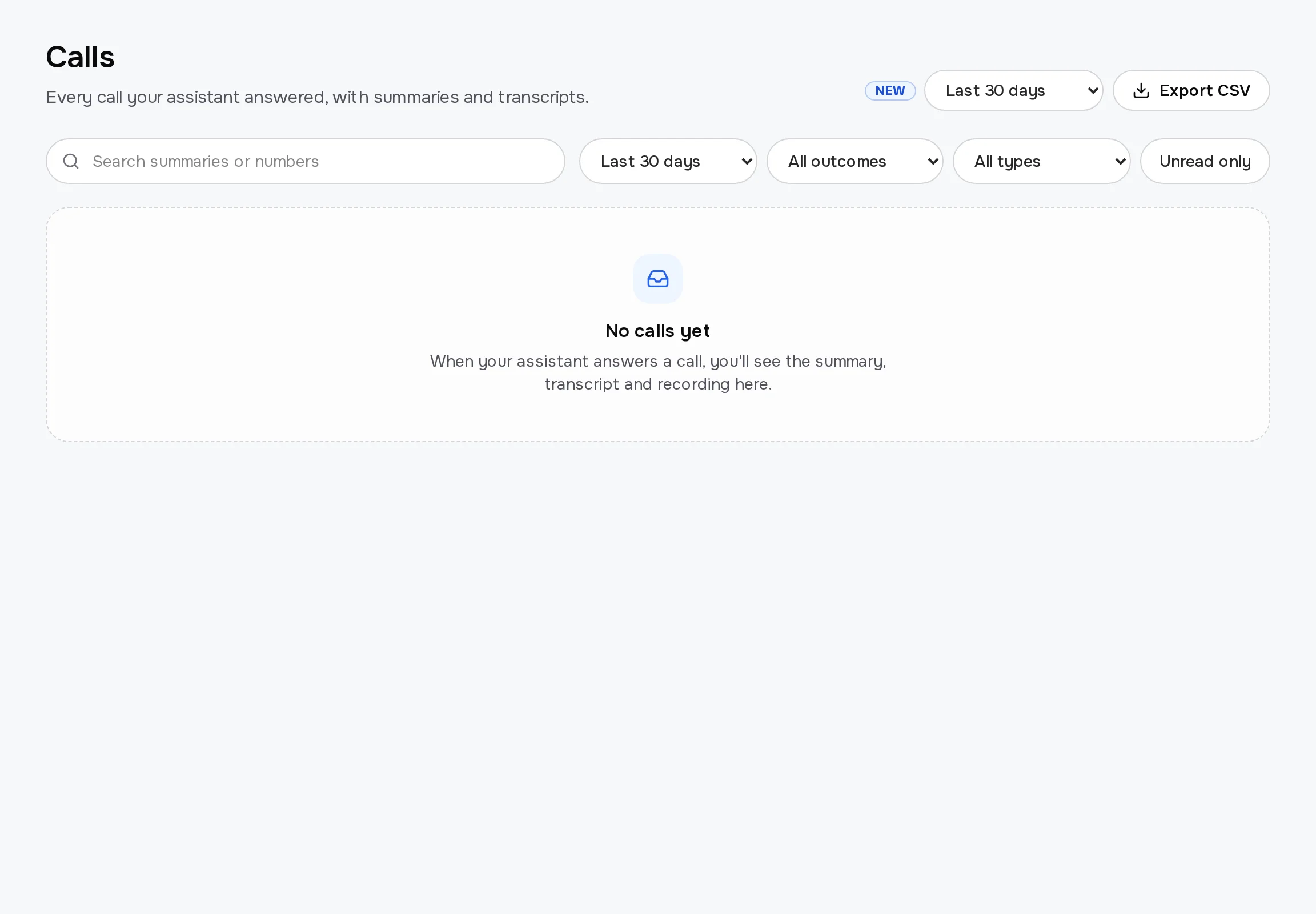
A CSV export of the last 7, 30 or 90 days shows the length of every call. That's ready-made data for the formula from the example. The rest of the setup is described on the how it works page.
What should you check before signing a contract?
Before you choose a call answering service, a remote receptionist or an AI assistant, ask the provider these questions.
- Allowance and overage — how many minutes or calls does the plan include, and what does each additional unit cost?
- How time is counted — does the service bill per second, per minute started or per call?
- Hours of cover — are evenings, weekends and bank holidays included in the price, or do they cost extra?
- One-off fees — what do setup, a script change or an additional number cost?
- Phone number — can you keep your current number, and how does forwarding work?
- Contract term — can you change plan or cancel without a penalty?
- Simultaneous calls — how many calls can the service handle at once before a caller hears the engaged tone?
How can you check the cost on your own calls?
The most reliable way to work out the cost is to test the assistant on the questions your customers really ask. Telofia gives you a 14-day trial with 30 free minutes, and you test the assistant in your browser without a card.
Paste your website address, make a few test calls and compare the result with the calculation in this article. Sign up and try Telofia, and check the plan limits on the pricing page.
Frequently asked questions
Is a virtual receptionist cheaper than an in-house receptionist?
With low to medium call volumes, usually yes, because you don't pay for hours without calls or for holidays and cover. In the article's example, with an assumed 600 call minutes a month, every remote and AI option comes out several times cheaper than the assumed cost of in-house staff.
What is an overage fee for minutes?
It's the rate for every call minute above the allowance included in your plan. With services billed per minute, overage is what most often pushes up the bill in busy months. That's why you should ask what it costs before signing a contract.
How many minutes a month does a small business need?
Multiply the number of calls in a month by the average call length. For example, 200 calls of 3 minutes each gives 600 minutes. Add a buffer for peak-season months so you don't pay overage.
Does forwarding calls to a virtual receptionist cost anything?
That depends on your phone provider and tariff, and the cost isn't the same for everyone. Check the forwarding charges in your provider's online account or ask their customer service.
Try Telofia on your own calls
Set up your AI receptionist in about five minutes: 14-day trial with 30 free minutes, no card needed for the browser test.
Prefer to hear it first?
Enter your number and the assistant calls you within seconds, acting as the receptionist of your business.
Also available in: Polski, Deutsch, Español, Français, Italiano, Português, Nederlands