Virtual Receptionist Pricing per Minute vs per Call or a Monthly Plan? (2026)
Telofia team · · 12 min read
Virtual receptionist pricing per minute vs per call or a monthly plan? With a few dozen calls a month, especially short ones, a per-minute or per-call rate works out cheaper. When the phone rings every day, a plan with bundled minutes gives a lower, predictable bill. Minimum charges, overage, out-of-hours surcharges and call rounding can flip the result, though.
Contents
- Virtual receptionist pricing per minute vs per call or a monthly plan: which pays off?
- How do the three pricing models work?
- What hidden costs lurk in price lists?
- How much does it cost per month? A worked example with assumptions
- Which model should you choose for low, medium and high call volumes?
- How does Telofia's AI phone assistant charge?
- What should you ask a provider before signing?
- Find out how many minutes you really need
- Frequently asked questions
Virtual receptionist pricing per minute vs per call or a monthly plan: which pays off?
The answer depends on how many calls you get and how long they last, not on the headline rate alone. Per-minute or per-call pricing suits low, irregular call volumes; a monthly plan with bundled minutes makes sense when the phone rings every day.
A virtual receptionist is a service where your business calls are answered remotely by a person or an AI phone assistant, and you pay under an agreed pricing model.
How do the three pricing models work?
In business call answering you will come across three basic models. Each splits the risk of rising call volumes differently between you and the provider.
- Per minute — you pay for every minute of conversation, so the bill grows with the length of your calls.
- Per call — you pay a fixed amount for every answered call, whether it lasted 30 seconds or 6 minutes.
- Monthly plan with bundled minutes — you pay a fixed monthly fee for an allowance of minutes, and once you go over it you pay overage or buy extra minutes.
Per-call pricing works against you with lots of short calls, per-minute pricing with long ones. A monthly plan costs you for unused minutes, because you pay for the allowance even in a quiet month.
What hidden costs lurk in price lists?
The biggest differences between offers come from the small print, not the base rate.
- Minimum charge — the amount you pay even if you only get a handful of calls in a month.
- Overage — the rate for minutes or calls above the limit, which can be higher than the per-minute price within the bundle.
- Out-of-hours surcharge — a higher rate in the evening, at weekends and on bank holidays; important for tradespeople who take emergency call-outs.
- Call rounding — billing in full minutes or blocks instead of per second pushes up the cost of every call.
- Spam and wrong numbers — on per-call pricing you also pay the full rate for calls from bots, survey callers and wrong numbers.
- Extra fees — setup, an additional number, call transfers, text messages to customers or access to recordings may be charged separately.
Pricing also depends on who answers the phone. With a telephone answering service, calls are handled by agents, so the cost is tied to their working time — ask there first about surcharges for nights, weekends and call transfers.
An AI phone assistant answers the same way at any hour, so the time of the call doesn't have to change the price. Even so, check the offer to see whether nights, weekends and transfers are charged at separate rates.
We show what these items can cost in a single breakdown in the example below.
How much does it cost per month? A worked example with assumptions
Under the assumptions in this example, per-minute pricing wins for short calls, per-call pricing for a few dozen longer calls, and a monthly plan from medium volume upwards. In a quiet month both pay-as-you-go models cost the same, because the minimum charge decides.
Example — assumptions shared by the whole table. All amounts in this example are illustrative, round figures in abstract price units excluding VAT; they are not pounds and not any provider's prices:
- Call length — 2.5 minutes on average, billed in full minutes, so 3 minutes on the invoice.
- Per minute — 2 units a minute, minimum charge 100 units a month.
- Per call — 5 units per call, minimum charge 100 units a month.
- Monthly plan — 400 units a month with a 600-minute allowance, overage 1 unit a minute.
- Variants — a short call lasts up to a minute and is billed as 1 minute; out of hours, a minute on per-minute pricing costs 3 units, with no surcharge on the other models.
| Scenario (example, amounts in units excl. VAT) | Per minute | Per call | Monthly plan |
|---|---|---|---|
| Quiet month: 10 calls, 30 minutes | 60 → 100 (minimum) | 50 → 100 (minimum) | 400 |
| Short calls: 40 calls of 1 minute | 80 → 100 (minimum) | 200 | 400 |
| Low volume: 40 calls, 120 minutes | 240 | 200 | 400 |
| Medium volume: 150 calls, 450 minutes | 900 | 750 | 400 |
| Medium volume, incl. 45 out-of-hours calls | 1035 | 750 | 400 |
| High volume: 400 calls, 1,200 minutes | 2400 | 2000 | 1000 (incl. overage) |
The cheapest model shifts with the number and length of your calls. Below 17 calls (per minute) and 20 calls (per call) you pay only the minimum charge in this example, so the pay-as-you-go model works like a hidden subscription.
Hidden costs in this example (illustrative amounts, in units excl. VAT):
- Minimum charge — in a quiet month you pay 100 instead of 60 or 50.
- Rounding — 0.5 minutes × a rate of 2 = an extra 1 on every call, so +150 at 150 calls; on the monthly plan that's 75 minutes used from the allowance.
- Out-of-hours surcharge — 45 calls × 3 minutes × a surcharge of 1 = +135 on per-minute pricing.
- Overage — 600 minutes over the allowance × 1 = 600, more than the plan itself.
Break-even points in this example: at 80 calls (80 × 5 = 400) the monthly plan and per-call pricing cost the same, and above 80 calls the plan works out cheaper. Compared with per-minute pricing, the plan is cheaper from about 67 calls (400 / 6 for 3 billed minutes).
With 1-minute calls, per-minute pricing matches the plan at 200 calls (200 × 2 = 400), so the plan only works out cheaper above 200 calls.
Which model should you choose for low, medium and high call volumes?
For low, irregular volumes choose per-minute or per-call pricing; for medium and high volumes, a monthly plan with a minute allowance that leaves some headroom.
- Few calls (a few dozen a month) — per-minute pricing if calls are short, or per-call if they're longer; check the minimum charge doesn't eat up the savings.
- Medium volume (anything from a few to a dozen or more calls a day) — a monthly plan with bundled minutes; the bill is fixed and easy to budget for.
- High volume or seasonal peaks — a plan with a larger allowance and a known price for extra minutes, for example for an air-conditioning service in summer or a heating engineer in autumn.
- Lots of calls at night and at weekends — an offer where 24/7 answering comes out of the same allowance, with no separate evening rate.
You can work out your own needs in five steps:
- Count your calls over 3 months
- Multiply by the billed call length
- Add headroom for peaks
- Compare with the allowance and minimum charge
- Work out the overage cost
We cover the other criteria besides price in How to Choose an AI Receptionist in 2026: A 12-Point Checklist.
How does Telofia's AI phone assistant charge?
Telofia uses a monthly plan with bundled minutes: every plan has a fixed monthly price, a minute allowance and a phone number.
It's an AI phone assistant that answers your calls: it picks up 24/7, books appointments in Google Calendar, takes messages and transfers urgent calls.
- No setup fee — you set up the assistant yourself in about five minutes; your existing number stays the same and you simply forward calls from it.
- Transfers included — live transfer to you or your team is in every plan.
- Overage under control — when your allowance runs out, you buy extra minutes under Billing or switch to a higher or lower plan.
- Blocked numbers use no minutes — a call from a number added under Blocked numbers ends immediately, with no conversation and no minutes used.
- Text messages included — appointment confirmations and reminders have a monthly limit in every plan.
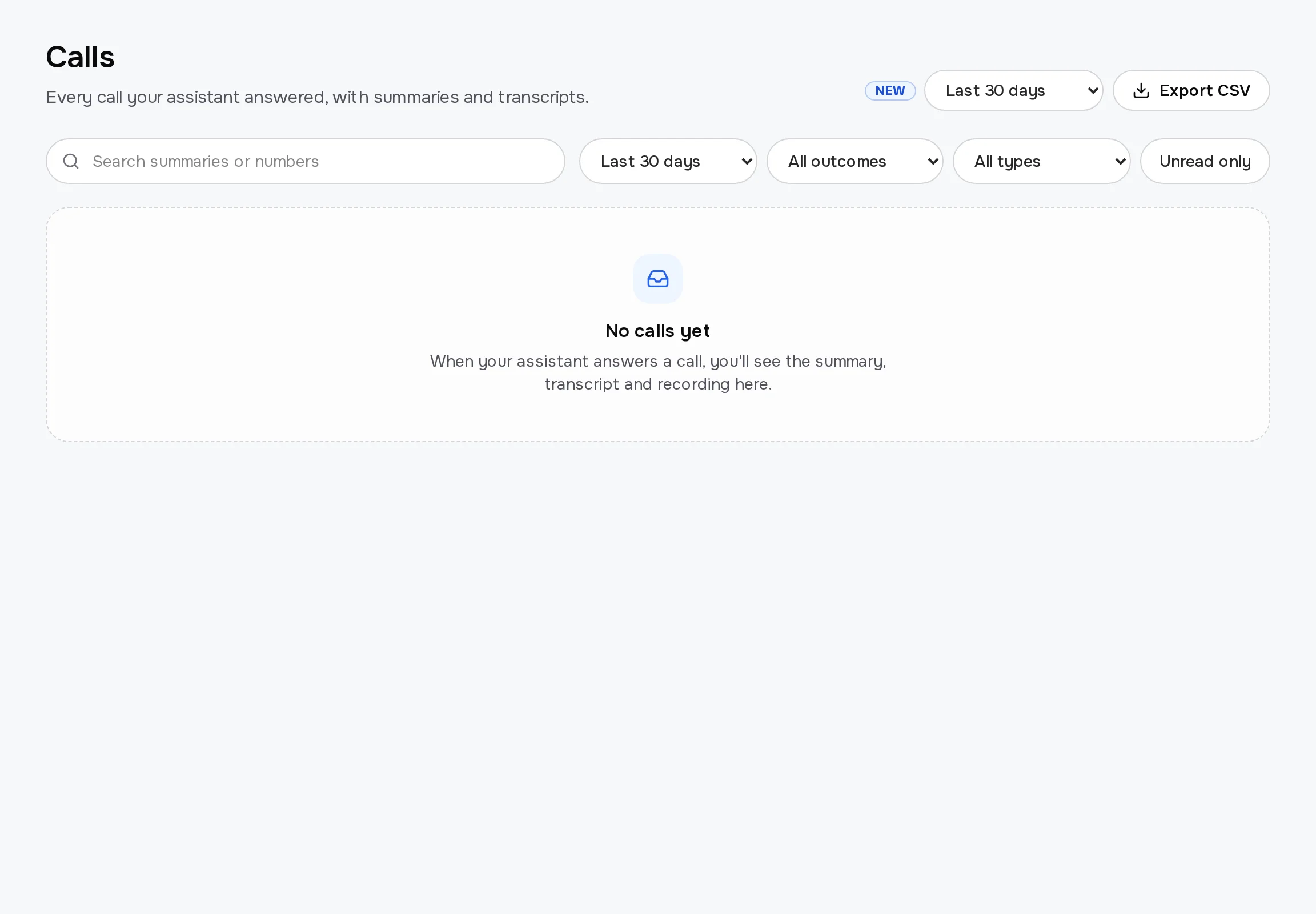
You can check your actual usage under Calls: every call has a summary and transcript, the recording is available for a period that depends on your plan, and the CSV export shows call durations for the last 7, 30 or 90 days.
At one of the businesses that work with Telofia — a salon — the assistant handles several dozen phone calls a month: it books appointments, confirms them by text and transfers callers to a member of staff when needed. Roughly one in three phone calls ends in a booked appointment or meeting.
Plans start at £35 a month excl. VAT on yearly billing — check the minute allowance and the price of extra minutes on the pricing page before you plug them into the formula. We show the setup step by step on how Telofia works.
What should you ask a provider before signing?
Ask for the answers in writing — these questions reveal the full monthly cost, not just the advertised rate.
- How is call time measured? — per second, in full minutes or in blocks; it changes the cost of every call.
- Is there a minimum charge? — how much you'll pay in a month with only a few calls, for example during the summer holidays.
- How much is overage? — compare the price of a minute over the limit with the per-minute price in your plan and in the next plan up.
- Do nights, weekends and bank holidays cost more? — crucial if you take emergency call-outs outside working hours.
- Do you pay for spam and wrong numbers? — ask whether you can block numbers and whether those calls are billed.
- Does transferring a call to you cost extra? — with frequent transfers, this item can push up the bill significantly.
- How do you change plans, and what's the notice period? — flexibility matters when call volumes rise or fall with the seasons.
If you're still comparing types of service, also read Telephone Answering Service Cost in 2026: UK Pricing Models Compared.
Find out how many minutes you really need
The surest way to choose a model is to test the assistant on your own scenarios, not just compare price lists.
You can try Telofia for 14 days with 30 free minutes — no card required. During the trial you run test calls in your browser and see how the assistant handles your customers' typical questions.
You'll see actual call durations under Calls once you choose a plan and connect a number — then it's easy to match the minute allowance to your numbers.
Create an account and test the assistant, then compare the result with our pricing.
Frequently asked questions
Is a monthly plan always cheaper than paying per minute?
No. With a few dozen short calls a month, per-minute or per-call pricing can be cheaper, because you're not paying for an unused allowance. A monthly plan wins when your call volume regularly exceeds the point at which the per-minute cost matches the plan price.
What is a minimum charge in a call answering service?
A minimum charge is a fixed amount you pay every month regardless of how many calls are answered. In practice it turns per-minute or per-call pricing into a hidden subscription, so always factor it in when comparing offers.
How do I budget if my calls have seasonal peaks?
Count the calls in your busiest and quietest months separately. Choose a plan that covers a typical month and check the price of extra minutes or whether you can switch plans temporarily for the peak season.
Do unused minutes roll over to the next month?
It depends on the provider and the contract terms, so ask before you sign. If minutes expire, size the allowance for a typical month, not a record one.
How can I find out how long my phone calls last?
Look at the itemised bill from your phone provider or the call history in your phone system, and divide the total call time by the number of calls. If the provider bills in full minutes, add the difference caused by rounding to the average.
Try Telofia on your own calls
Set up your AI receptionist in about five minutes: 14-day trial with 30 free minutes, no card needed for the browser test.
Prefer to hear it first?
Enter your number and the assistant calls you within seconds, acting as the receptionist of your business.
Also available in: Polski, Deutsch, Español, Français, Italiano, Português, Nederlands