Answering Service vs AI Receptionist: Which Is Better in 2026?
Telofia team · · 11 min read
Answering service vs AI receptionist: which is better? For a small business with repetitive calls, such as appointments, quotes or questions about opening hours, an AI receptionist is usually the better choice. It answers 24/7, books appointments into your calendar and costs a fixed monthly subscription. A human answering service wins where empathy, sensitive matters and human judgement count.
Contents
- Answering service vs AI receptionist: which is better for a small business?
- How do they differ in practice? A side-by-side comparison
- What does it cost: pay per call or a subscription?
- Which handles callers and bookings better?
- When is a human answering service still the better choice?
- How does it work in Telofia?
- Checklist: what to ask before you choose
- Test which works better on your own calls
- Frequently asked questions
Answering service vs AI receptionist: which is better for a small business?
For most small businesses that get similar calls, an AI receptionist is the better choice, because it answers at any time and deals with the request there and then. A telephone answering service with live receptionists is better when calls are unusual, emotional or need a human decision.
A telephone answering service is an outsourced service where receptionists answer calls on your behalf, greet callers with your business name and pass messages on to you.
An AI receptionist (AI phone assistant, virtual receptionist) is software that holds a voice conversation, answers questions about your business, books appointments into your calendar and transfers urgent matters to people.
How do they differ in practice? A side-by-side comparison
The biggest differences are in opening hours, how you're billed, how peaks are handled and whether a call ends with a message or a confirmed booking.
| Criterion | Telephone answering service (people) | AI receptionist |
|---|---|---|
| Availability | Hours as per contract; check nights and weekends | 24/7, including weekends and bank holidays |
| Pricing model | Usually per call, per minute or a bundle of calls | Fixed subscription with included minutes |
| Answer speed and peaks | Depends on how many receptionists are free; callers may queue | Answers straight away; number of simultaneous calls depends on the plan |
| Call quality | Empathy and flexibility, varying from one receptionist to another | Consistent, following your rules and knowledge of your business |
| Booking appointments | Depends on the service; often just a message | Books into your calendar during the call |
| Spam and sales calls | The receptionist screens them out, but check whether you pay for them | Blocks selected numbers, e.g. in Telofia without using minutes |
| Knowledge of your business | A script prepared with the provider | Learns from your website and FAQ |
| Languages | Depends on the receptionists available | Several languages, depending on the provider (e.g. Telofia: 8) |
| Call record | A note or email from the receptionist | Summary, recording and transcript |
| Best for | Sensitive, unusual matters that need judgement | Repetitive calls, appointments, quotes, out-of-hours cover |
If most of your calls can be described in a few scenarios, AI has the advantage. If every other call is different and needs a light touch, a human is the stronger option.
What does it cost: pay per call or a subscription?
A telephone answering service usually charges for every call handled or every minute, so you pay more when more customers ring. An AI receptionist runs on a subscription where minutes are included until you go over your allowance.
Telofia costs from £35 a month (excl. VAT) on yearly billing, and you'll find full plan details on our pricing page.
Example – assumptions: the answering service charges a flat rate per call with no fixed fee, an average call lasts 2 minutes, and the sample AI subscription includes 400 minutes:
- 200 calls a month – the answering service bill is 200 × the per-call rate. The AI assistant uses 200 × 2 min = 400 minutes, which fits within the allowance, so you pay only the subscription.
- 400 calls a month – the answering service bill doubles. The AI assistant needs around 800 minutes, so on top of the subscription you pay for extra minutes or a higher plan.
As call volume grows, the cost of AI rises too, but in steps rather than with every single call. So compare both options using your own figures:
- Telephone answering service – check the monthly fee, the price per call or per minute, and surcharges for nights, weekends and call transfers.
- AI receptionist – check the included minutes, the price of extra minutes, the number of simultaneous calls and whether a phone number is included.
Plug your own numbers from your phone bill and the quote you've received into the formula. We cover pricing models for human answering services in detail in Telephone answering service cost in 2026: UK pricing models compared.
Which handles callers and bookings better?
When it comes to booking appointments, AI wins, because it sees your real calendar and books a slot during the call. In conversations that need a light touch, such as an upset customer with an unusual problem, an experienced human has the edge.
An answering service receptionist often has no access to your diary, so they take the caller's details and ask you to ring back. The customer waits, and after work you call back a list of people, some of whom have already found someone else.
An AI phone assistant takes every call through the same sequence:
- Customer calls the business
- Assistant asks about the service and preferred time
- Checks free slots in the calendar
- Customer confirms the details
- Appointment in the calendar, SMS if switched on
Example: a plumber is on site and can't answer. The assistant asks about the type of fault and the address, offers two or three free slots and puts an urgent emergency through to them live.
At one business that works with Telofia – a service salon – the assistant books appointments and meetings into the calendar, confirms them to customers by SMS and connects callers to a member of staff when needed. Roughly one in three phone calls there ends with a booked appointment or meeting.
When is a human answering service still the better choice?
A service with live receptionists is better when calls need empathy, judgement or decisions that can't be written down as rules. To be fair: AI won't replace a human in every industry.
- Sensitive and emotional matters – calls after a bereavement, in a crisis or with an extremely upset customer.
- Unusual enquiries – when almost every call is different and needs probing in lots of ways.
- Negotiations and complaints – when someone has to decide on a discount, an exception or compensation.
- Customers who expect a human – some people simply prefer to talk to a person, and that's worth respecting.
What does this look like in specific industries? The scenarios below are examples based on assumptions, not market data:
- Funeral director or law firm – assumption: most calls are conversations with grieving families or descriptions of a case that require tact and confidentiality. Here a human works better on the front line, and AI at most takes a message out of hours.
- Beauty salon – assumption: around eight in ten calls are about booking, moving or cancelling an appointment. These calls follow a set pattern, so AI with calendar access can handle them from start to finish.
- Plumber or heating engineer – assumption: most calls are job requests and quotes, with the occasional urgent breakdown. AI collects the address and a description of the fault and books a slot, while emergencies are put through to the engineer live.
Many businesses do best by combining both. A sample hybrid model looks like this:
- During working hours (e.g. 8–16) – calls are answered by you, someone on your team or a human answering service.
- After hours, at weekends and when you can't pick up – calls go to the AI through call forwarding on no answer, when the line is busy or when your phone is unreachable.
- Urgent matters – a transfer rule connects the caller to the person on call; if nobody answers, the assistant takes a message.
- The next morning – you review the call summaries and only call back where a human is needed.
How does it work in Telofia?
Telofia is an AI receptionist that answers your business calls 24/7, books appointments, takes messages and transfers urgent calls. At the start of every call it tells the caller they're speaking to an AI.
Setup takes about five minutes: paste your website address, test the assistant in your browser and forward your calls. You keep your existing number, and a Telofia number is included in every plan.
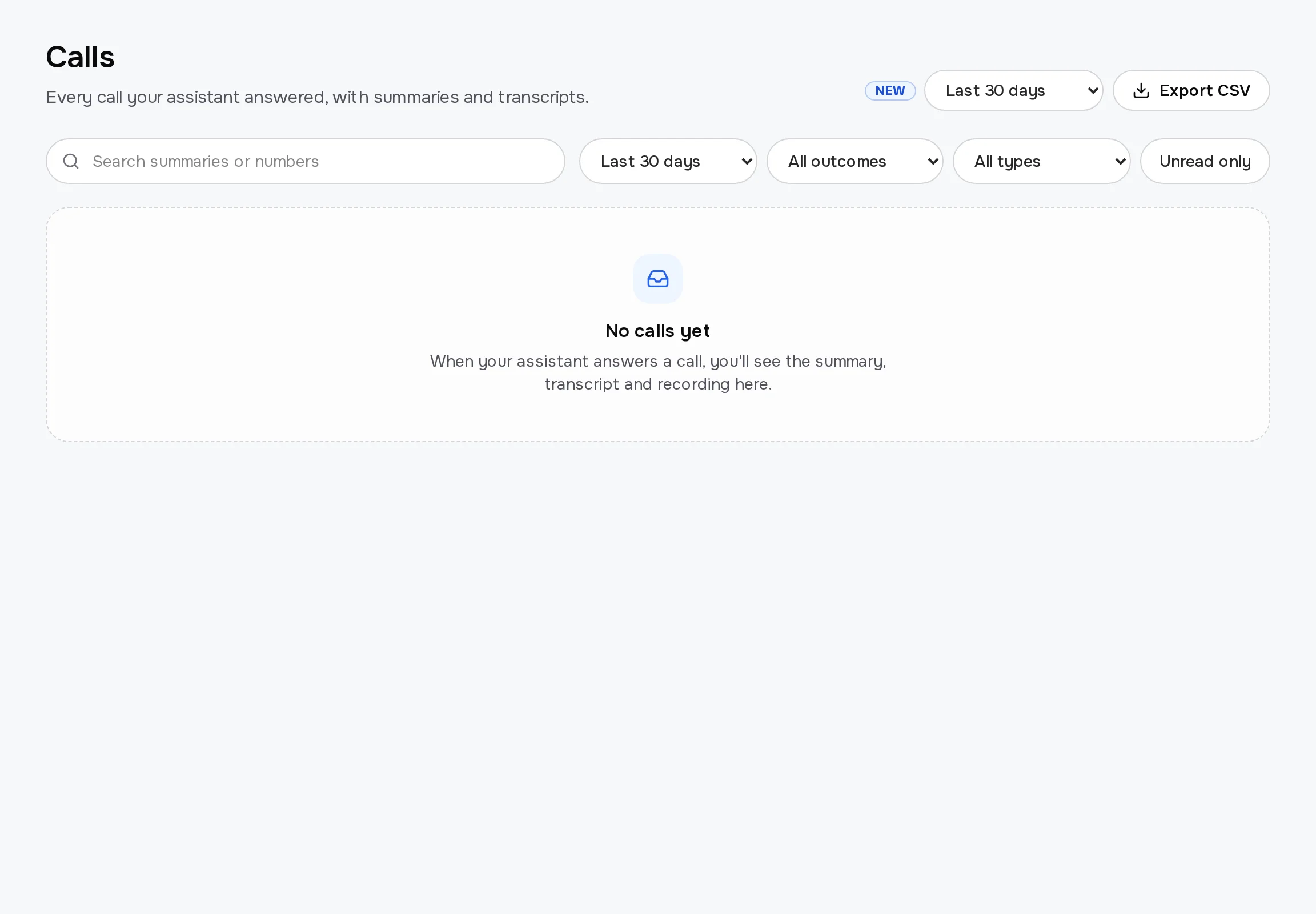
Every call goes into the Calls list. In each call you'll find the Summary, Recording and Transcript, and how long recordings are kept depends on your plan.
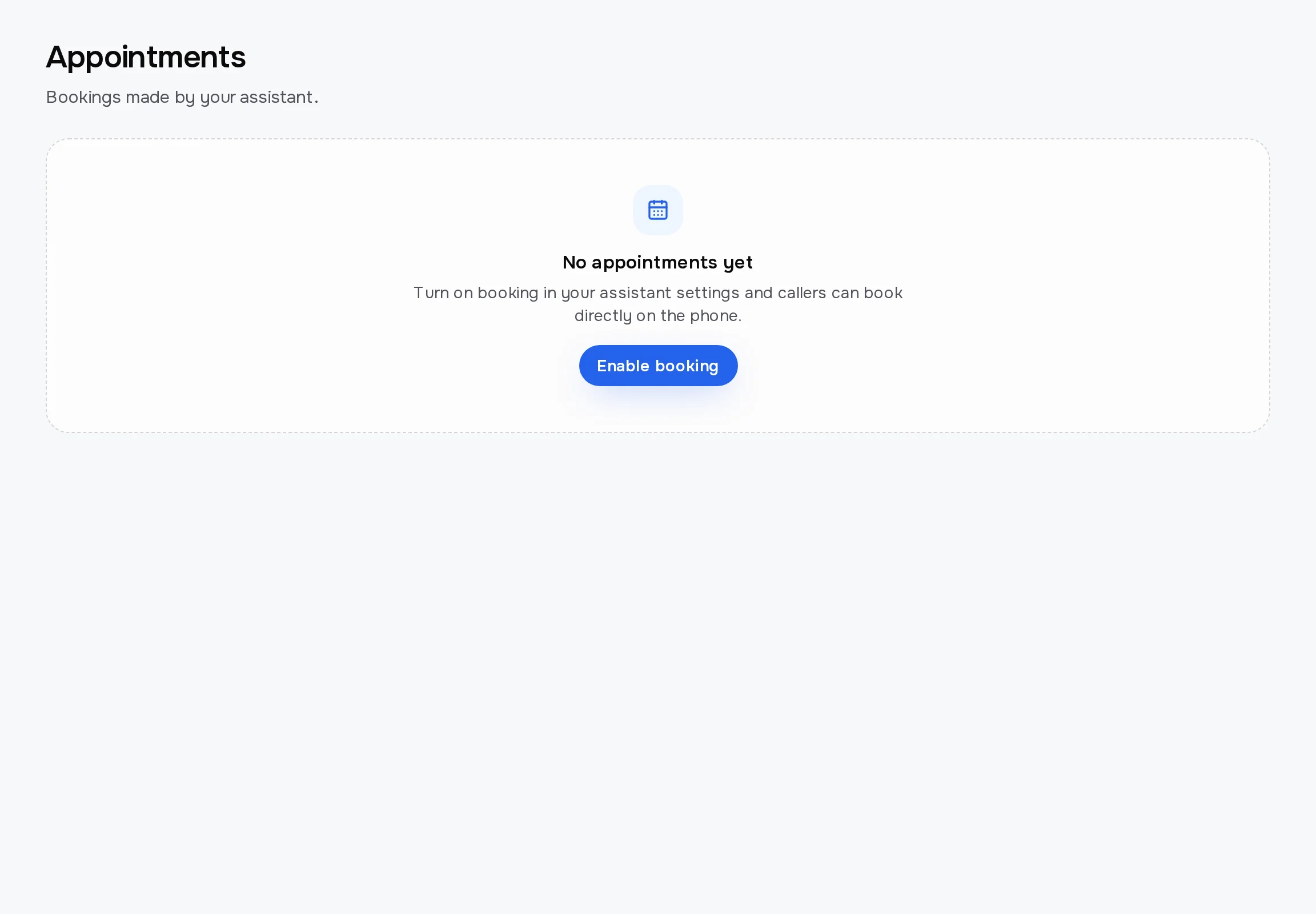
You can see booked appointments under Appointments in the sidebar or in your connected Google Calendar. The assistant only books a slot once the customer confirms, and you switch on SMS confirmations and reminders in Automations.
Other settings, such as opening hours, transfer rules, number blocking and the knowledge base, are covered on our how it works page.
Checklist: what to ask before you choose
Before you sign a contract with an answering service or choose an AI assistant, check these points against your own data:
- Call volume and timing – how many calls you get a month and what share comes in the evenings and at weekends.
- Purpose of the call – whether customers mainly want to book an appointment or get a quote, or discuss a matter that needs a decision.
- Calendar access – whether the service books a slot straight away or just takes a message for you to call back.
- Several calls at once – how many calls it can handle simultaneously and what the caller hears when the line is busy.
- Transfer to a human – when and to whom an urgent call goes, and what happens if nobody answers.
- Cost as you grow – how much you'll pay if your call volume doubles, and whether you also pay for spam.
- Data and compliance – where recordings are stored and whether you get a data processing agreement (Telofia stores data in the EU, in Frankfurt).
Test which works better on your own calls
The simplest way to settle this choice is to test the assistant on the calls you actually get. Make a test call in your browser: ask a typical question, request an appointment, try to move it and judge the result.
You can try Telofia for 14 days with 30 free minutes, and your first test runs in the browser with no card needed. Create an account and see whether the assistant can handle your customers.
Frequently asked questions
Is an AI receptionist cheaper than a telephone answering service?
It depends on your call volume. Divide the monthly AI subscription by the answering service's per-call rate – above that number of calls, AI works out cheaper, because the answering service charges for every call while the subscription has a fixed price until your minutes run out. Beyond your allowance you buy extra minutes or change plan, so compare both costs using your own figures.
Do callers know they're talking to an AI?
Yes. Telofia tells callers at the start of every call that they're speaking to an AI assistant. The conversation then continues in a natural voice in the caller's language.
Can I combine AI with a human answering calls?
Yes. You set transfer rules, for example for urgent matters, and the assistant puts the caller through live to you or your team; if nobody answers, it takes a message. During the 14-day free trial, transfers are switched off and the phone number only comes with a plan, so you test in the browser and with the website widget.
Do I have to change my business phone number?
No. You keep your existing number and forward calls to the assistant, for example only when you don't answer. That way you can still take calls yourself during the day.
Which languages does the assistant speak?
Telofia speaks 8 languages: English, Polish, German, Spanish, French, Italian, Portuguese and Dutch. It recognises the caller's language in the first sentence and switches automatically.
Try Telofia on your own calls
Set up your AI receptionist in about five minutes: 14-day trial with 30 free minutes, no card needed for the browser test.
Prefer to hear it first?
Enter your number and the assistant calls you within seconds, acting as the receptionist of your business.
Also available in: Polski, Deutsch, Español, Français, Italiano, Português, Nederlands